Overview
Last month, Parker Harris stood in front of a room full of press and analysts and said something that caught everyone off guard.
“Why should you ever log into Salesforce again?”
Coming from the co-founder of a platform that hundreds of thousands of businesses log into every single day – that’s not a throwaway line. That’s a signal.
It turned out to be the opening act for what Salesforce announced at TrailblazerDX 2026 on April 15 in San Francisco. The announcement was called Salesforce Headless 360, and if you run your business on Salesforce – or you’re thinking about it – this is one of those moments worth pausing on.
So What Actually Changed?
For most of Salesforce’s history, the platform worked one way. You opened a browser, found your record, clicked through the screens, and did your work. Everything happened inside the UI. That was just the deal.
Headless 360 breaks that assumption entirely.
What Salesforce has done is expose its entire platform – every workflow, every piece of business logic, every data model built over 25 years – as something that can be called programmatically. An API. An MCP tool. A CLI command. Your AI agents, your coding tools, and your external systems can now reach into Salesforce and act on it directly. No browser. No human navigating screens.

Think about what that actually means in practice. A sales rep logging a call. A service agent updating a case. A manager is pulling a weekly report. Every one of those actions – currently done by a human sitting inside Salesforce – can now be handled by an AI agent running in the background. Your people get their time back for the decisions that actually need a human.
That’s not a feature update. That’s a different kind of platform.
The Three Things Headless 360 Actually Delivers
- Build from wherever your developers already work
Salesforce has shipped 60+ new MCP tools and 30+ preconfigured coding skills. If your developers work in Claude Code, Cursor, Codex, or Windsurf, they now have full, live access to your Salesforce org from inside those tools. Data, workflows, business logic – all of it, without switching context into a Salesforce UI. For development teams, this is a genuinely significant unlock.
- Put Salesforce where your users already are
A new layer called the Agentforce Experience Layer means agents can surface interactions natively in Slack, WhatsApp, voice, and mobile – without sending anyone back to a browser tab. You build the experience once. It renders wherever your team works.

- Keep control of what agents actually do
This is the pillar that gets the least attention but matters most in production. Salesforce has built a governance layer that includes session tracing, testing centres, and custom scoring evaluations. You can define what “correct” looks like for your specific use case – and measure agent behaviour against that standard before and after go-live. For any organisation worried about agents going rogue in a production environment, this is the layer that makes deployment responsible.
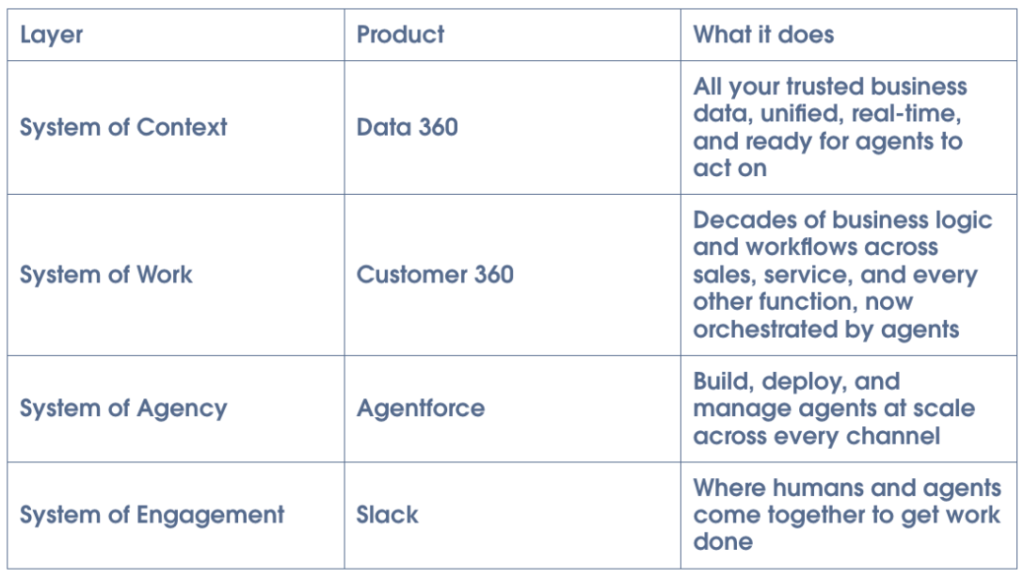
The four layers that underpin all of this: Data 360 gives agents the context they need. Customer 360 gives them the workflows to act on. Agentforce manages how they operate. And Slack is where humans and agents come together to get work done.
One layer that deserves more than a passing mention here is Agent Fabric. It sits across your entire agentic environment and handles automated discovery, centralised LLM governance, and monitoring dashboards that give you visibility into every agent handoff and model decision – with optimisation across cost and risk built in. The concept is exactly right. How it performs in production at scale is what we’ll be watching closely over the next few months.

Why This Is a Business Story, Not Just a Tech Story
We’ve seen plenty of platform announcements that are exciting for developers and largely irrelevant to business leaders. This one is different.
The question worth asking isn’t “what new features did Salesforce ship?” It’s “how much of my team’s working week is spent navigating Salesforce instead of making decisions?” For most organisations, that number is uncomfortably high. Logging calls. Updating records. Generating reports. These are tasks that carry real labour costs and no strategic value.
Headless 360 is Salesforce’s answer to that problem. It’s not perfect yet – we’ll get to that – but the direction is clear, and the businesses that start thinking about it now will be better positioned than those who wait.
Six More Announcements Worth Your Attention:
Headless 360 was the headline at TDX 2026, but it wasn’t the only significant news. These announcements complete the picture.
- AgentExchange – One Marketplace for Everything

Salesforce has unified its AppExchange, Slack Marketplace, and Agentforce ecosystem into a single platform called AgentExchange. It brings together roughly 10,000 Salesforce apps, 2,700 Slack apps, and 1,000+ Agentforce agents, tools, and MCP servers – all searchable and deployable in one place. A new $50 million Builders Fund backs partners building within the ecosystem.

For businesses, the practical implication is straightforward. Rather than commissioning custom builds for every workflow you want to automate, you can browse a catalogue of pre-built, pre-certified agents designed for your industry and use case. That lowers the barrier to getting started considerably.
One more thing worth noting: Salesforce also announced integration with ChatGPT, putting Agentforce within reach of consumer AI surfaces most people already use daily. Details are still limited, but the direction is consistent with everything else at TDX – meet users where they already are, not where the platform wants them to be.
- Agentforce Vibes 2.0 – Smarter Developer Tooling
If Headless 360 is the infrastructure, Agentforce Vibes 2.0 is the development environment sitting on top of it. The meaningful upgrade here is multi-model support – Claude Sonnet 4.5 is the default coding model, and developers can build using either the Anthropic or OpenAI agent SDK depending on their needs. More importantly, Vibes 2.0 understands your org’s specific data model and existing code patterns. It’s not a generic AI assistant – it knows what your objects mean and how your business has configured them. That’s a practical difference.
It also introduces two distinct operating modes. Plan Mode proposes changes before executing them – useful when you’re working in a production environment and want to review before anything runs. Act Mode executes directly, built for faster iteration in sandboxes. Choosing between them thoughtfully will save teams a lot of pain.

- Free Developer Edition – Start Today
Every Salesforce Developer Edition org now includes the Agentforce Vibes IDE and Salesforce Hosted MCP Servers at no cost – 110 requests and 1.5 million tokens per month, available through May 31, 2026. No budget sign-off required. No procurement process. Just a Developer Edition org and a few hours.
If your team has been curious about agentic Salesforce development but hasn’t found a low-stakes way to explore it, this is that opportunity. Use it before the free allocation runs out.
- React on Salesforce – Building Natively on the Platform
Salesforce Multi-Framework is now in open beta, and it deserves more attention than it got in the TDX coverage. For the first time, developers can build native React apps directly on the Agentforce platform – using GraphQL, Apex, and Salesforce’s built-in security model – without stitching together a separate front-end stack.

The connection to Agentforce Vibes is what makes this practical rather than just interesting. You describe what you need – say, a dashboard showing open Opportunities by stage – and Vibes generates the React code, GraphQL queries, and Salesforce metadata. Live Preview updates in real time as you build. Templates handle the scaffolding.
For teams that have spent years choosing between a custom front-end experience and staying inside native Salesforce functionality, this closes a gap that’s caused a lot of unnecessary compromise.
- Informatica Is Now Part of Salesforce
This one moved quietly in the TDX noise, but it’s worth slowing down on. Informatica – one of the most recognised names in enterprise data management – is now inside the Salesforce ecosystem.
What that actually means in practice: data integration, data quality, governance, access and privacy controls, and master data management are now part of the same platform your agents are running on. The data that those agents act on can be cleaned, governed, and certified without routing through a separate set of tools managed by a separate team.

For any organisation where data quality has been the quiet reason AI initiatives stall before they start, this changes the conversation.
- Agentforce Labs – For the Experimenters
If you have developers who want to get ahead of the roadmap, Agentforce Labs is worth knowing about. It’s where Salesforce’s product and engineering teams ship unreleased tools, open-source projects, and early AI research — specifically for external builders to test and give feedback on before anything goes GA.
It’s not a production resource. But if your team has the appetite for it, it’s probably the most direct line of influence you’ll have over where Agentforce goes next.

- The Builder Gap – An Honest Assessment
Not everything from TDX 2026 is straightforward good news. Industry analysts – including the team at SalesforceDevops.net who first named this pattern – have highlighted what they’re calling a widening “Builder Gap.”
The reality is that Headless 360, MCP tools, Agent Script, and the broader agentic toolkit are firmly in pro-code territory. The Salesforce ecosystem was built by admins, declarative builders, and low-code professionals who never needed to understand API architectures or CLI pipelines. Those people were not the audience at TDX 2026. Flow Builder and point-and-click customisation were absent from the keynote narrative.
If your Salesforce team is primarily admin-led, the path to taking advantage of Headless 360 involves a real skills investment – whether that’s training, hiring, or bringing in a partner who can bridge the gap. We’d rather you hear that now than discover it mid-project.
Our Honest Read on This
We’re genuinely excited about where Salesforce is heading. But we also believe our clients deserve a complete picture, not just the headline.
A few things to think carefully about before making architectural decisions:
- On pricing – Salesforce has not yet disclosed how Headless 360 capabilities will be licensed at enterprise scale. The Developer Edition tools are free now. That won’t necessarily remain true in production. Given how Salesforce has historically packaged new capabilities into premium tiers, we’d strongly recommend having that conversation with your account team before building dependencies on these features.
- On maturity – Several high-value features, including the Testing Centre and the Salesforce Catalog, are still rolling out through May and June 2026. Running extended pilots in a sandbox before committing to production is simply good practice at this stage of availability.

- On SLAs – For teams building real-time agent workflows, response time guarantees on MCP tool calls are a real operational consideration. Salesforce hasn’t formally addressed these yet. If predictable latency matters for your use case, get that clarity before go-live.
None of these concerns diminishes what was announced. They’re just the questions a responsible partner asks before helping a client build on something new.
What Should You Actually Do Now?
If you’re already on Salesforce, this is the moment for a strategic conversation about your roadmap – not your feature list.
The right questions aren’t about what Headless 360 can do. They’re about what your organisation is ready for:
- Which of our processes are genuine candidates for agent-driven automation?
- Where does human judgment remain essential – and where is it just habit?
- What does a responsible governance model look like for agentic workflows in our environment?
- Do we have the developer capability to take advantage of this, or do we need to build it?
- Have we clarified pricing and licensing before making any architectural commitments?
These are the conversations we have with our clients every day. They’re not always comfortable, but they’re the ones that lead to outcomes that actually hold up.
The Bottom Line
Salesforce Headless 360 is one of the most significant changes to the platform in its 25-year history. It moves Salesforce from a place people navigate to, to infrastructure that operates on your behalf – across every surface, with or without a browser.
The AgentExchange marketplace, Agentforce Vibes 2.0, the free Developer Edition, and a raft of supporting announcements make this more accessible than any previous wave of Salesforce innovation. But the Builder Gap is real, pricing clarity is still outstanding, and several features aren’t fully GA yet. The businesses that approach this thoughtfully – rather than reactively – will be the ones that get ahead.
Thinking about what Headless 360 means for your organisation?
We’re helping businesses across the region work out where agentic Salesforce fits into their strategy – and where it doesn’t. Let’s have that conversation.
📩 contact@aekot.com 🌐 www.aekot.com 📞 +1 415 800 3212
#Salesforce #AgenticAI #HeadlessSalesforce #TrailblazerDX #CRM #DigitalTransformation #AIStrategy #MCP #Agentforce #SalesforcePartner